Need any help or advice? +44 (0)1782 454499
Downloads (3)
This is a chemical product. Before storage or use you must download and read the accompanying safety and technical datasheets.
 | Safety Datasheet (SDS) - EN |  1 MB 1 MB |
| Safety Datasheet (SDS) - NL | 1 MB |
| Technical Datasheet (TDS) | 183 KB |
Specification
Product Data
| Colour | Clear | |
|---|---|---|
| Chemistry / Material | Epoxy | |
| Viscosity | 550 | mPa.s |
| UV Resistance | Moderate | |
| Brand | Easy Composites | |
| Shelf Life | 12 | Months |
Cured Mechanical Properties
| Max Service Temp | 170 | °C |
|---|---|---|
| Hardness | 87 (Hard) | Shore D |
| Flexibility | Hard / Rigid | |
| Tensile Strength | 20 - 25 | MPa |
| Flexural Strength | 62.0 - 67.0 | MPa |
| Flexural Modulus | 2.6 - 3.0 | GPa |
| Elongation at Break | 1.0 - 2.0 | % |
| Tg Onset (DMA) | 170 | °C |
Pot Life and Cure Times
| Pot Life (Typical) | 330 | mins |
|---|---|---|
| Initial Cure Time | 24 | Hrs |
Weight and Dimensions
| Density | 1.15 | g/cm³ |
|---|
General Properties
| Gross Weight | 0.591 | kg |
|---|
Shipping Information
Restrictions
In the currently selected pack size, this product is classed as dangerous goods in limited quantity for the purposes of transport.
Shipping is possible to all UK addresses, including the Channel Islands, without restriction. However, due to being classed as 'dangerous goods', delivery times are not guaranteed on any delivery service.
Shipping to EU countries is now done through our European subsidiary based in the Netherlands. All EU customers should use www.easycomposites.eu.
To check availability of shipping to any other country, add the item to your basket and use the shipping calculator on the basket page.
For a full information regarding the shipment of dangerous goods to all destinations, see our delivery information page.
Package Size
There are no package size restrictions or surcharges for this product.
Delivery Cost
To find the availability and cost for delivery of this item to your address, add it to your basket and then use the instant shipping calculator on the basket page.
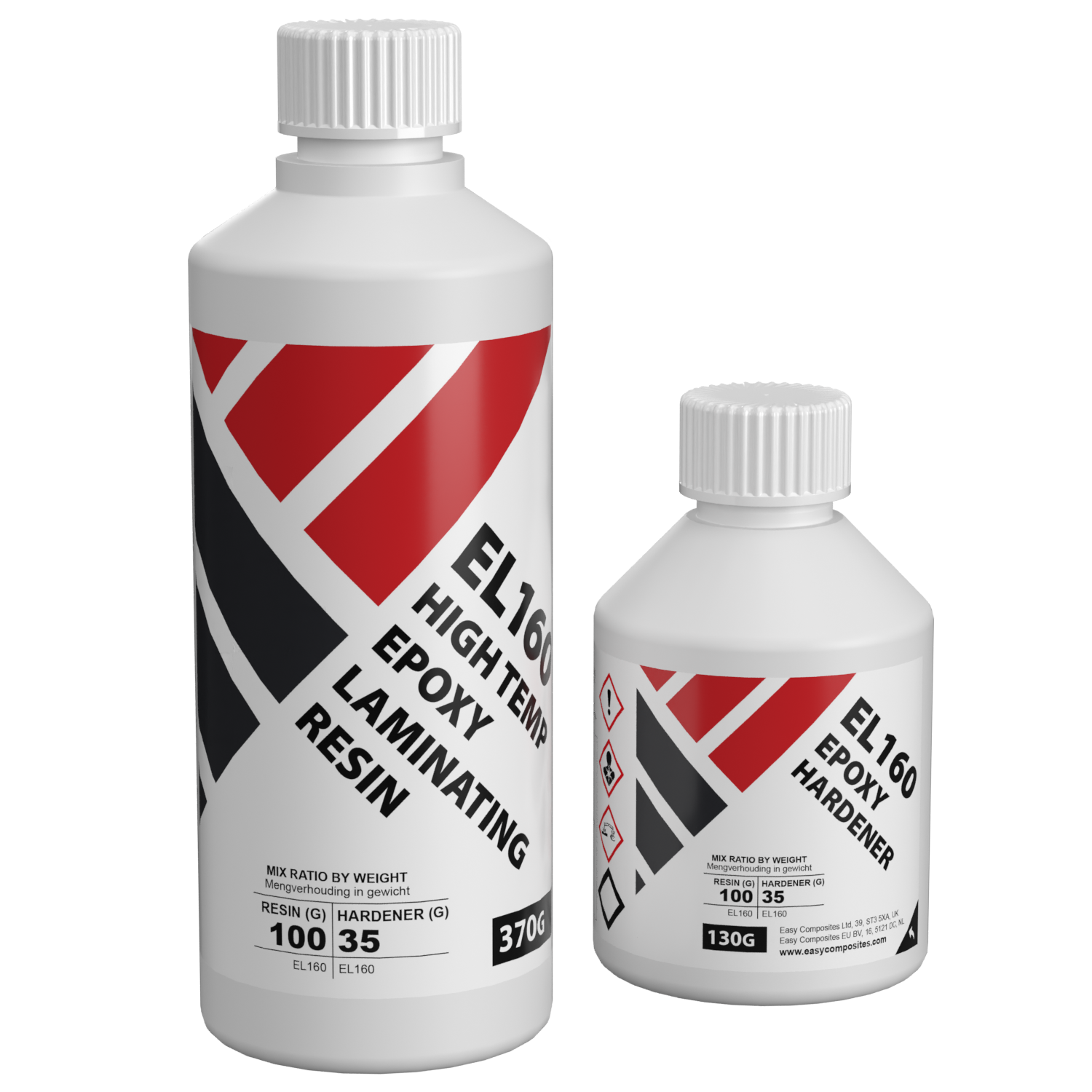
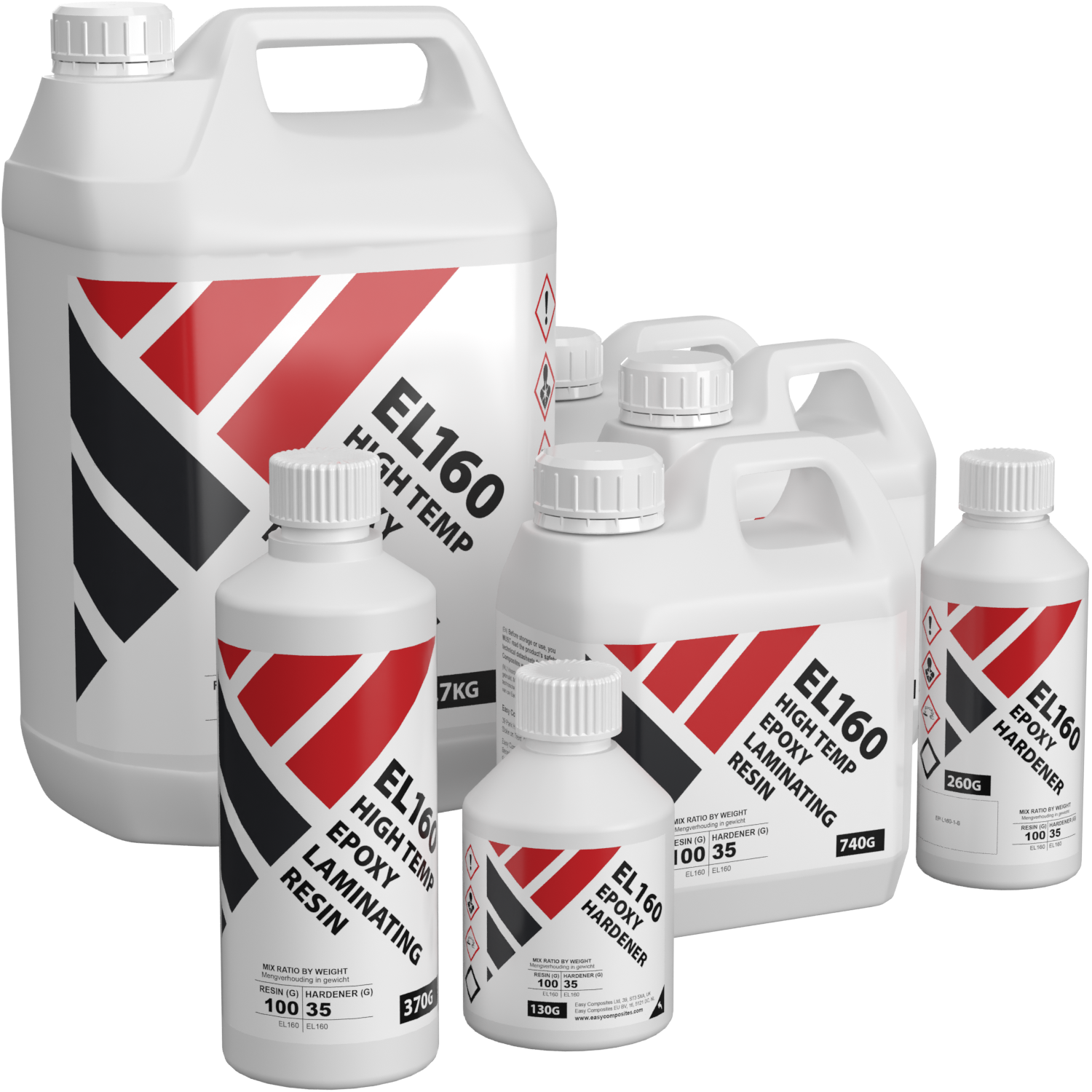
EL160 High Temp Epoxy Laminating Resin
- EP-L160-05
 Hazardous
- No reviews
EL160 is a very high performance epoxy resin suitable for the hand layup/hand laminating of high temperature composite moulds and components for use up to 170°C. It offers exceedingly high mechanical performance and good wet-out of fibres and is ideal for use with high performance reinforcements such as carbon and aramid fibre.
Sold as a kit (resin and hardener). Available to buy online in 500g, 1kg, 5kg and 33.75kg kits.
PRODUCT VERSIONS
Kit Size
AVAILABILITY:More than 10 availablefor immediate shipping
We won’t be beaten on price!
If you believe you’re buying an equivalent product cheaper elsewhere, contact us to discuss your requirements.
EL160 is a high performance epoxy laminating resin designed for use at service temperatures up to 170°C. The resin is compatible with a wide range of reinforcement materials including glass fibre (typically for mould making) and high performance fibres such as carbon fibre and aramid (e.g. Kevlar®). The cured mechanical properties of EL160 are outstanding.
The EL160 high temperature epoxy resin is ideally suited to the production by hand layup of high temperature components and high temperature moulds (including prepreg moulds).
As well as its high HDT, this epoxy system also has good clarity, a low viscosity and exceptional wetting characteristics when used with glass, carbon or aramid fibre.
Typical Uses
The resin is suitable for use in the hand-laminated production of high temperature components or tooling (moulds), vacuum bagging of composite parts, R.I.M. tooling, vacuum forming and other applications requiring dimensional stability at high temperatures.
Further Information
Starter Kit Compatibility
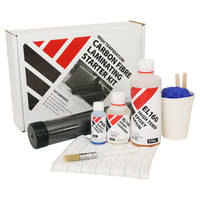
This is the resin used in the high-temperature version of our carbon fibre laminating starter kit.
Initial Cure
EG/EL/EMP160 can be cured to a demouldable state in 24hrs at 25C but at this stage can be brittle and prone to cracking during demoulding of more complex mould shapes. Therefore, in most cases, it is recommended to conduct the initial cure at 40C (whereby the cure time can be reduced to 12hrs). Conducting the initial cure at 40C is low enough to avoid distortion of the pattern whilst still curing the resin to an adequately non-brittle state to demould without risk of damage.
Recommended: 12hrs @ 40C
Alternative: 24hrs (min) @ 25C - Warning: Resin will be very brittle before post-cure
Key Processing Information
Consult the technical datasheet and safety datasheet for important information. When using EL160 for the production of high temperature epoxy moulds (tools) it is critical to ensure that there are no voids within the laminate or between the gelcoat and the reinforcement. If voids or air pockets are present then there is a good chance that the air will expand and result in blistering/delamination, either during the post cure or another cure cycle.
- Ease of Use: Suitable for professional and hobby use (follow SDS advice).
- Odour: Very High Temperature Laminating Resin is almost odourless.
- Safety Precautions: Wear gloves and goggles and work in a well ventilated area. Always read the SDS before use.
- Ambient Conditions: Can be used from 15 to 30°C although pot-life and cure time will be affected significantly. Recommended working at an ambient of 20-25°C
- Degassing: Not necessary.
- Mix Ratio: Mix 'Resin' and 'Hardener' 100:35 by weight. Use digital scales.
- Mixing: Mix thoroughly by hand for at around 2 minutes.
- Pot-Life: 5-6 Hours at room temperature. Be sure to use your resin before this time.
- Exotherm (Over-Heating): Resin will heat-up whilst it cures. Mix in small batches and use expediently. Mixed resin in a pot will overheat (exotherm) and can smoke/ignite. Never leave mixed, unused resin unattended.
- Cure Time/Demould: At 25°C you can expect a typical demould time to be around 24hrs with a full cure achieved in 1 week
- Pigments and Fillers: As a laminating resin, use of fillers or pigments is unlikely. Potentially fumed silica (for thickening) glass bubbles (for reducing density) or aluminium powder (for increasing thermal mass and conductivity) could be considered.
- Post Cure: To achieve 170°C HDT, follow post cure cycle in TDS.
EL160 is a high performance epoxy laminating resin designed for use at service temperatures up to 170°C. The resin is compatible with a wide range of reinforcement materials including glass fibre (typically for mould making) and high performance fibres such as carbon fibre and aramid (e.g. Kevlar®). The cured mechanical properties of EL160 are outstanding.
The EL160 high temperature epoxy resin is ideally suited to the production by hand layup of high temperature components and high temperature moulds (including prepreg moulds).
As well as its high HDT, this epoxy system also has good clarity, a low viscosity and exceptional wetting characteristics when used with glass, carbon or aramid fibre.
Typical Uses
The resin is suitable for use in the hand-laminated production of high temperature components or tooling (moulds), vacuum bagging of composite parts, R.I.M. tooling, vacuum forming and other applications requiring dimensional stability at high temperatures.
Further Information
Starter Kit Compatibility
This is the resin used in the high-temperature version of our carbon fibre laminating starter kit.
Initial Cure
EG/EL/EMP160 can be cured to a demouldable state in 24hrs at 25C but at this stage can be brittle and prone to cracking during demoulding of more complex mould shapes. Therefore, in most cases, it is recommended to conduct the initial cure at 40C (whereby the cure time can be reduced to 12hrs). Conducting the initial cure at 40C is low enough to avoid distortion of the pattern whilst still curing the resin to an adequately non-brittle state to demould without risk of damage.
Recommended: 12hrs @ 40C
Alternative: 24hrs (min) @ 25C - Warning: Resin will be very brittle before post-cure
Key Processing Information
Consult the technical datasheet and safety datasheet for important information. When using EL160 for the production of high temperature epoxy moulds (tools) it is critical to ensure that there are no voids within the laminate or between the gelcoat and the reinforcement. If voids or air pockets are present then there is a good chance that the air will expand and result in blistering/delamination, either during the post cure or another cure cycle.
- Ease of Use: Suitable for professional and hobby use (follow SDS advice).
- Odour: Very High Temperature Laminating Resin is almost odourless.
- Safety Precautions: Wear gloves and goggles and work in a well ventilated area. Always read the SDS before use.
- Ambient Conditions: Can be used from 15 to 30°C although pot-life and cure time will be affected significantly. Recommended working at an ambient of 20-25°C
- Degassing: Not necessary.
- Mix Ratio: Mix 'Resin' and 'Hardener' 100:35 by weight. Use digital scales.
- Mixing: Mix thoroughly by hand for at around 2 minutes.
- Pot-Life: 5-6 Hours at room temperature. Be sure to use your resin before this time.
- Exotherm (Over-Heating): Resin will heat-up whilst it cures. Mix in small batches and use expediently. Mixed resin in a pot will overheat (exotherm) and can smoke/ignite. Never leave mixed, unused resin unattended.
- Cure Time/Demould: At 25°C you can expect a typical demould time to be around 24hrs with a full cure achieved in 1 week
- Pigments and Fillers: As a laminating resin, use of fillers or pigments is unlikely. Potentially fumed silica (for thickening) glass bubbles (for reducing density) or aluminium powder (for increasing thermal mass and conductivity) could be considered.
- Post Cure: To achieve 170°C HDT, follow post cure cycle in TDS.
Specification
Product Data
| Colour | Clear | |
|---|---|---|
| Chemistry / Material | Epoxy | |
| Viscosity | 550 | mPa.s |
| UV Resistance | Moderate | |
| Brand | Easy Composites | |
| Shelf Life | 12 | Months |
Cured Mechanical Properties
| Max Service Temp | 170 | °C |
|---|---|---|
| Hardness | 87 (Hard) | Shore D |
| Flexibility | Hard / Rigid | |
| Tensile Strength | 20 - 25 | MPa |
| Flexural Strength | 62.0 - 67.0 | MPa |
| Flexural Modulus | 2.6 - 3.0 | GPa |
| Elongation at Break | 1.0 - 2.0 | % |
| Tg Onset (DMA) | 170 | °C |
Pot Life and Cure Times
| Pot Life (Typical) | 330 | mins |
|---|---|---|
| Initial Cure Time | 24 | Hrs |
Weight and Dimensions
| Density | 1.15 | g/cm³ |
|---|
General Properties
| Gross Weight | 0.591 | kg |
|---|
Good question. The timing of the post-cure is definitely not critical in the same way, for example, that the 'B-stage' is when making the moulds in the first place would, but the post-cure should still be undertaken whilst the resin systems are still continuing to harden. For the EG160/EMP160/EL160 system this would mean ideally undertaking the post-cure within around 7 days of reaching initial cure at room temperature.
Although it is possible to infuse with this resin it is higher viscosity than a typical infusion resin so would not infuse as quickly as a dedicated infusion resin. As the resin would travel slowly, larger parts may need more resin distribution (normally spiral). The long pot life means it can be successfully used for smaller infused parts, or a set-up with more spiral distribution, where the higher viscosity is not a significant barrier to resin flow over short distances.
The problem would be the long term impact of hot oil on the surface of the resin. Although epoxies in general have a good level of chemical resistance to most types of oil, any additives or combustion contamination is likely to be more aggressive on the surface leading to degradation and contamination compromising the part.
Yes, for higher temperature applications you can use EL160 in the same way that IN2 is used in the Forged Carbon Development Kit.
It's worth noting that EL160 is a higher viscosity (thicker) resin than IN2 and so it will take more time and effort to ensure that it has fully wetted-out the chopped tow, however, it also has a much longer pot-life and so you have all the time you could possibly need in order to do this.
...removed from the buck and then post cured for OOA prepreg layup? The reason for removing from the buck is that the buck won't take the heat of post curing.
Yes, this can be done. Ideally we would suggest a moderate temperature post-cure on the pattern (buck) as high as you're comfortable taking the pattern (maybe 40 degrees C for example). You could then cool and demould before post-curing the mould to the higher service temperature. There are a lot of considerations when doing this (many of which are discussed in more detail in the product's datasheet) but the most importing things are a very gentle increase in temperature (i.e. a slow ramp rate) which should minimise the risk of any distortion.
EL160 Epoxy will bond to most other resin surfaces - including polyester - as long as the surface has been suitably abraded and cleaned ready for application. However, the EL160 is a high temperature capable resin system so care should be taken when post curing and in service to ensure that any other resin systems underneath are also suitable for high temperature work.
Both materials can be used. Glassfibre is more cost effective and can actually be easier to laminate with because you can see air pockets while laminating. Carbon fibre requires a little more care when laminating to avoid trapped air (which can't be seen through the reinforcement) but brings the advantage of a lower coefficient of thermal expansion (CTE) which means carbon reinforced moulds will remain more dimensionally accurate at high temperatures.
A good rule of thumb would be that if you'll be using a mould at elevated temperature to make carbon fibre parts then it would be best to make the mould out of carbon fibre too.
In theory, yes it could, however I would be concerned about the interaction between the resin and wood at high temperatures. Wood is likely to distort at high temperatures and the High Temperature Epoxy needs to be post-cured at elevated temperatures in order to achieve its high HDT (heat distortion temperature). If you heated the wood and resin to post-cure the resin and the wood distorted whilst the resin cures completely then it's likely that when the part cools the resin would be cured in a distorted state.
Because our Very High Temperature Epoxy Resin needs to be post-cured in order to acheive its high temperature properties, it's important that you use a release agent which is high temperaure comptible and so we would strongly recommend our Easy-Lease Chemical Release Agent. Providing that the mould or pattern material is compatible, Easy-Lease should ensure a very easy release from of the cured resin from your pattern or mould.
It may well be suitable but it would depends on the actual temperature the exhaust gets to in use. Our Very High Temperature Resin will work up to 180°C (following a suitable post cure). It’s likely that none of the outer surfaces of a motorcycle end can would be running hotter than 180°C but ideally we would recommend measuring this with an infra-red thermometer to be sure. Don’t forget, post curing the resin (see datasheet) would be essential.
Yes, the addition of metal filler powders, particularly Aluminium Powder can help to improve the thermal dimensional stability, for example in high temperature tooling where increasing the thermal conductivity of the resin can help to reduce distortion that can arise from temperature differential across the laminate. It should be noted that the addition of metal filler powders won’t actually increase the glass transition (Tg) temperature of the system.
Yes, certainly. This is a very high performance epoxy which is why it's well-suited to use with high performance reinforcements like carbon fibre and aramid fibre but there is no reason at all why it can't be used with woven glass, in fact it performs very well with glass.
The ratio is 100:35 (resin to hardener). Like all our epoxies the hardener is included with the resin, in the correct ratio.
Yes, our Very High Temperature Epoxy Resin can be laminated into a condensation or addition cure silicone mould
This is not an application this resin has been tested for so we cannot be certain if it would work. We see no reason why, in theory, it should not work, however without some testing we cannot be 100% sure. So we would recommend you test the epoxy first in a non-critical application to get the necessary test results.
We would not recommend using this resin for a worktop or counter as the properties are not best suited for that application. As a laminating resin, this resin is not formulated with UV protection in mind and nor does it readily self-level to give the uniform finish you would want from such a worktop resin. Additionally, it is slightly amber in colour which would affect the finished colour of the worktop. Finally, to achieve the high temperature properties of this resin, the piece would need to be post-cured in an oven which is often impractical for large worktops as well as the high chance of the substrate warping or distorted during the process.
We are not aware of a worktop coating resin that offers a high temperature resistance, along with the usual requirement for clarity, UV stability and glossy self-levelling. If you can protect the worktop from high temperatures then we do have an outstanding bartop/countertop resin - our GlassCast Clear Epoxy Surface Resin. GlassCast features include amazing clarity, a high level of UV stability, self-levelling and no need to degas. It is ideal for many worktop or decorative table top applications and it is what we would recommend where you can accept the need to protect the surface from high temperatures.
ASK YOUR OWN QUESTION
Customer Product Reviews for EL160 High Temp Epoxy Laminating Resin
SUBMIT YOUR OWN PRODUCT REVIEW
We publish all reviews for verified purchases. Submit your own review and help other customers with their choices.SUBMIT YOUR OWN PRODUCT REVIEW
We publish all reviews for verified purchases. Submit your own review and help other customers with their choices.Shipping Information
Restrictions
In the currently selected pack size, this product is classed as dangerous goods in limited quantity for the purposes of transport.
Shipping is possible to all UK addresses, including the Channel Islands, without restriction. However, due to being classed as 'dangerous goods', delivery times are not guaranteed on any delivery service.
Shipping to EU countries is now done through our European subsidiary based in the Netherlands. All EU customers should use www.easycomposites.eu.
To check availability of shipping to any other country, add the item to your basket and use the shipping calculator on the basket page.
For a full information regarding the shipment of dangerous goods to all destinations, see our delivery information page.
Package Size
There are no package size restrictions or surcharges for this product.
Delivery Cost
To find the availability and cost for delivery of this item to your address, add it to your basket and then use the instant shipping calculator on the basket page.
Shipping Information
Restrictions
In the currently selected pack size, this product is classed as dangerous goods in limited quantity for the purposes of transport.
Shipping is possible to all UK addresses, including the Channel Islands, without restriction. However, due to being classed as 'dangerous goods', delivery times are not guaranteed on any delivery service.
Shipping to EU countries is now done through our European subsidiary based in the Netherlands. All EU customers should use www.easycomposites.eu.
To check availability of shipping to any other country, add the item to your basket and use the shipping calculator on the basket page.
For a full information regarding the shipment of dangerous goods to all destinations, see our delivery information page.
Package Size
There are no package size restrictions or surcharges for this product.
Delivery Cost
To find the availability and cost for delivery of this item to your address, add it to your basket and then use the instant shipping calculator on the basket page.
100% SECURE


PAYMENT METHODS






Easy Composites Ltd, registered in England 7486797. All content copyright (C) Easy Composites Ltd, 2025. All rights reserved.